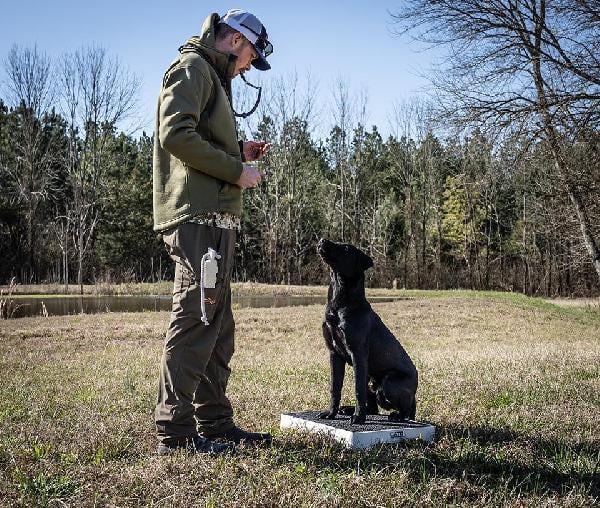
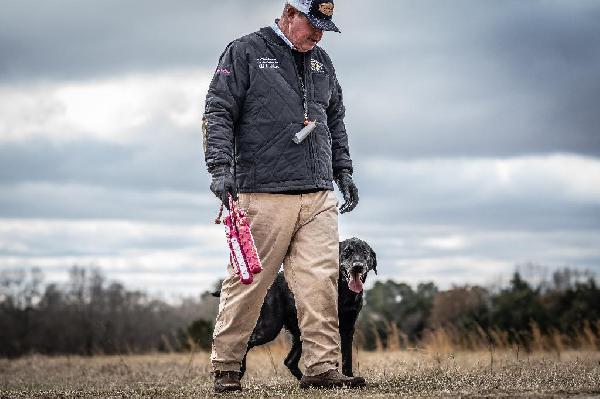
Think back to a time when you first started school or a new job. You were probably nervous and didn't know what to expect. How did you make it through those first few months? You had to learn the expectations and how to perform the tasks needed to make you successful. This might have meant performing certain tasks multiple times until you were proficient, or maybe you learned by watching others do the task. It is the same way with your dog when you are beginning training sessions. You have to teach them what you expect of them, and this could mean a lot of repetition for certain tasks. Take your time, don't compare your retriever to other dogs even littermates (they are all different). Be consistent, take your time, join a train group, don't quit. The rewards outweigh the work!
People often ask how consistent they should be when training their pets. In my experience, there are two components to consistency when teaching a dog your expectations. Those components are the frequency/length of training sessions and the quality of the training session. After years of training, I have found that short training sessions 4-5 times a week are more beneficial than one or two long sessions each week. This makes things easier for you and your pet. Most dogs don't have an attention span that allows for multiple hours of training at once, and most pet owners would rather not spend hours at a time (probably on your days/weekend off) training.
There are several ways to maximize your training time and ensure good quality. For each session, use the same commands in a firm tone, set up drills in the same manner, and
discipline/reward consistently for each expectation. Setting up drills the same way each time does not mean having the dog do the same drill repeatedly. For example, setting up a retrieving drill could consist of four components: sit, mark, throw, release. You can begin with short distances/easily found targets (low or no cover) and progress to a higher level of difficulty while keeping the key components of the drill the same. Sit or steady. Make sure your dog is under control. Mark watches the bird go down while remaining steady. Release only releases when commanded to go. Once mastered simple singles in low cover, add higher cover, longer distance then add multiple marks. Remember when you advance a skill you may have to take a step backwards. My final piece of advice would be to always end training sessions on a good note where your pet will be eager to train next time!
Remember: consistency is a combination of quantity (frequency and time spent) and quality (setting your pet up for success). Training your pet is a process that takes time, patience, and effort. Keep the end goal in mind and work!
Kevin owns Southern Pine Kennel in Blackshear, GA, where he offers a full range of dog training services. They have indoor and outdoor kennels facilities and are state licensed. He is a certified dog trainer and fully insured. Kevin is an avid hunter, mostly wing shooting dove, duck, geese, quail, and turkey. He typically hunts in Georgia, Florida, Arkansas, and Missouri. In 2016, he opened Southern Pine Kennel after training his own dogs for years. His program is designed for hunters that want to bring a well-mannered and trained dog into the field.
In 2017, he retired from U.S. Homeland Security after 26 years of Law Enforcement. His last duty was to the Federal Law Enforcement Training Center as a Firearms Instructor. For the last 10 years he has trained Federal, State and Local Law Enforcement in handguns, shotguns, and rifles. Students were taught proper safety, weapons handling, nomenclature, proper maintenance, and proper marksmanship. He continues to teach firearms to individuals in his community and contractually for Homeland Security
He is currently a Pro Staff member for Retay Shotguns. He is also with Heybo, Dakota Kennels and National Pro Staff. You can find him regularly posting about his dogs on Instagram and Facebook as @southern_pine_kennel.
To become successful hunting companions, sporting breed puppies have a lot of skills to master. Clicker training is a great training method for any of the sporting breeds. The method is simple and it marks and then rewards good behavior. Ev.. more ..
When you have trained multiple dogs, once you find what works for you, it is natural to stick with the same method for each dog you train. If the way you introduce them to gun fire works, why change? If your drills for steadiness are succes.. more ..
When I started training retrievers professionally in 1972, I believed that dogs needed to be worked six days a week, for at least a half hour each day. If you have a big kennel, you know that’s a lot of work. After a few years and trainin.. more ..