Hup or Sit?
Understanding One of the Most Important Commands in a Hunting Cocker Spaniel
Posted 06/18/2026
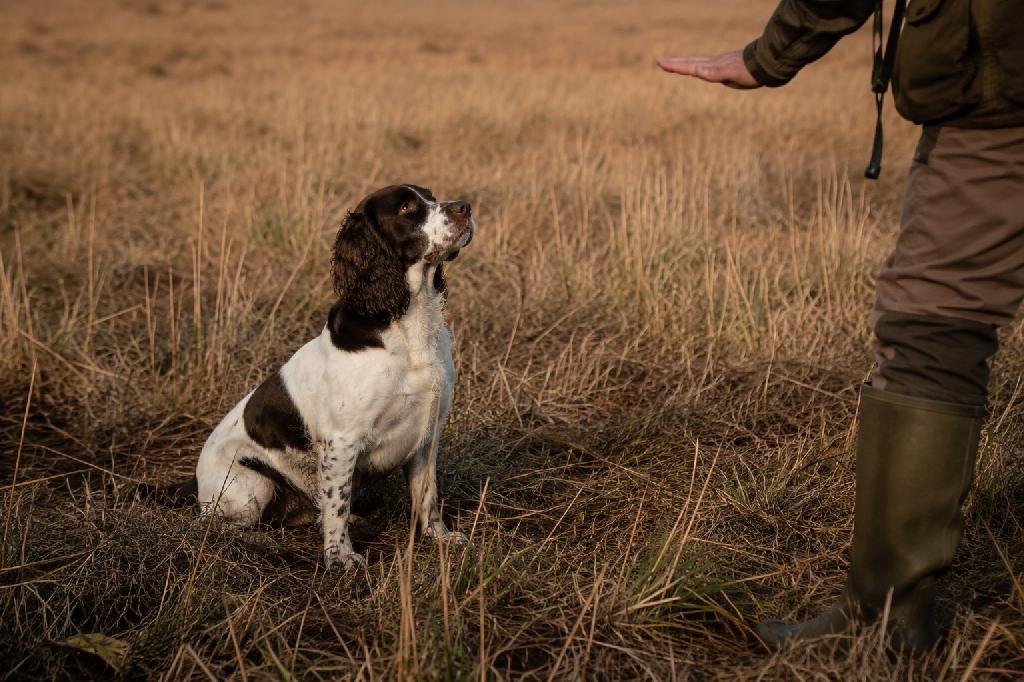
If you've spent any time around working English Cockers, you've probably heard handlers use the word "hup" almost as often as they use a whistle.
To someone new to the breed, it can be confusing. Why not just teach the dog to sit? Isn't sitting and hupping the same thing?
Well, yes and no.
Over the years, I've trained a lot of hunting cockers, and one of the most common questions I get from new owners is whether they should teach a sit command, a hup command, or both. The answer depends on what you expect from your dog and how you plan to use him in the field.
Let's talk about what hup really means, where it came from, and why many cocker handlers consider it one of the most important commands a dog can learn.
What Is "Hup"?
Traditionally, hup is a command that tells the dog to stop what he's doing immediately and plant himself until further instruction.
In many dogs, that position happens to be a sit.
But the command is bigger than the posture itself.
When I tell a cocker to hup, I'm not asking him to perform a trick. I'm asking him to shut down all forward momentum, focus on me, and wait for direction.
That's an important distinction.
A dog can sit and still be mentally disconnected. A proper hup means the dog's attention comes back to the handler.
Think of it as the canine equivalent of saying:
"Freeze. Pay attention. Wait."
Why Cockers Traditionally Use Hup
English Cockers were developed as close-working flushing dogs. Their job is to hunt thick cover, stay within gun range, and flush birds for the shooter.
Because they work close, handlers need a reliable way to stop them instantly.
Picture a cocker working through briars along a hedgerow. A pheasant erupts from cover. The dog should stop immediately rather than chase.
That stop allows the gun to operate safely, gives the handler control, and prevents the dog from pushing birds out of range.
For generations, British spaniel handlers used the hup command for exactly this purpose.
The command became part of the culture of spaniel work, especially among cockers and springers.
Even today, if you watch spaniel field trials in the United Kingdom, you'll hear handlers using hup constantly.
Why Some Trainers Prefer "Sit"
Many modern trainers simply use the word "sit" instead.
There's nothing wrong with that.
The dog doesn't care what word you use. The command could be sit, hup, freeze, or banana if you're consistent enough.
The advantage of sit is that everyone understands it.
Family members understand it.
Pet trainers understand it.
Veterinarians understand it.
If your cocker spends as much time on the couch as he does in the field, teaching sit may simplify things.
For some owners, one command is easier than maintaining separate field and household vocabulary.
The Problem With Using Sit for Everything
Here's where things get interesting.
A lot of dogs learn sit as a casual obedience command.
Sit before dinner.
Sit before going outside.
Sit for a treat.
Sit for visitors.
After thousands of repetitions, the command can become routine.
The dog may respond, but not with the same intensity and urgency required in hunting situations.
When a bird explodes from cover and adrenaline spikes, I want a command that means one thing and one thing only:
Stop immediately.
That's one reason many hunting trainers keep hup separate from everyday obedience.
The command maintains its importance because it isn't diluted by daily household use.
My Preference for Hunting Cockers
Personally, I teach both.
The dog learns sit as a basic obedience behavior.
The dog learns hup as a field-control command.
Physically, the result may look identical. The dog sits.
Mentally, the meaning is different.
When I say sit around the house, I'm asking for obedience.
When I say hup in the field, I'm asking for complete control and immediate attention.
Over time, dogs learn the difference remarkably well.
The Whistle Hup
Eventually, I want the dog responding to a whistle just as quickly as a verbal command.
Most spaniel handlers use a single sharp blast on a whistle to mean hup.
The beauty of whistle training is range.
A cocker working thirty yards away may not hear your voice in the wind.
He'll hear a whistle.
The goal is simple:
One blast.
The dog's rear hits the ground.
Eyes come back to the handler.
No hesitation.
No extra steps.
No negotiation.
That's when you know the command is becoming reliable.
Common Mistakes
One mistake I see often is repeating the command.
"Hup... hup... HUP!"
Every repetition teaches the dog that the first command wasn't important.
Give the command once.
Enforce it.
Reward compliance.
Another common mistake is only practicing in low-distraction environments.
Dogs don't fail commands because they forgot them.
They fail because excitement overwhelms training.
A cocker that hupps perfectly in the backyard may suddenly forget everything when quail start flushing.
Training has to progress gradually into increasingly exciting situations.
Building a Reliable Hup
I start young dogs in quiet environments.
First, I teach the behavior.
Then I teach duration.
Then I teach distance.
Only after those pieces are solid do I introduce distractions.
The progression might look like this:
* Living room
* Backyard
* Training field
* Light bird work
* Multiple bird contacts
* Actual hunting situations
Too many handlers skip straight to the last step and wonder why the dog struggles.
Reliability is built one layer at a time.
The Bottom Line
Whether you use the word "hup" or "sit" matters far less than consistency.
The dog doesn't care about the vocabulary.
What matters is that the command carries meaning, is enforced fairly, and is practiced often enough to become automatic.
That said, for a dedicated hunting cocker, I still like preserving the traditional hup command.
It connects today's dogs to generations of spaniel work that came before them, and it gives the handler a distinct command reserved for moments when control matters most.
When a rooster pheasant erupts from a patch of cover, a covey of quail bursts from a hedgerow, or a rabbit bolts from thick briars, that's not the time to wonder whether your dog understood what you meant.
One sharp whistle.
One immediate hup.
A cocker sitting attentively, waiting for the next instruction.
That's spaniel work at its finest.
To someone new to the breed, it can be confusing. Why not just teach the dog to sit? Isn't sitting and hupping the same thing?
Well, yes and no.
Over the years, I've trained a lot of hunting cockers, and one of the most common questions I get from new owners is whether they should teach a sit command, a hup command, or both. The answer depends on what you expect from your dog and how you plan to use him in the field.
Let's talk about what hup really means, where it came from, and why many cocker handlers consider it one of the most important commands a dog can learn.
What Is "Hup"?
Traditionally, hup is a command that tells the dog to stop what he's doing immediately and plant himself until further instruction.
In many dogs, that position happens to be a sit.
But the command is bigger than the posture itself.
When I tell a cocker to hup, I'm not asking him to perform a trick. I'm asking him to shut down all forward momentum, focus on me, and wait for direction.
That's an important distinction.
A dog can sit and still be mentally disconnected. A proper hup means the dog's attention comes back to the handler.
Think of it as the canine equivalent of saying:
"Freeze. Pay attention. Wait."
Why Cockers Traditionally Use Hup
English Cockers were developed as close-working flushing dogs. Their job is to hunt thick cover, stay within gun range, and flush birds for the shooter.
Because they work close, handlers need a reliable way to stop them instantly.
Picture a cocker working through briars along a hedgerow. A pheasant erupts from cover. The dog should stop immediately rather than chase.
That stop allows the gun to operate safely, gives the handler control, and prevents the dog from pushing birds out of range.
For generations, British spaniel handlers used the hup command for exactly this purpose.
The command became part of the culture of spaniel work, especially among cockers and springers.
Even today, if you watch spaniel field trials in the United Kingdom, you'll hear handlers using hup constantly.
Why Some Trainers Prefer "Sit"
Many modern trainers simply use the word "sit" instead.
There's nothing wrong with that.
The dog doesn't care what word you use. The command could be sit, hup, freeze, or banana if you're consistent enough.
The advantage of sit is that everyone understands it.
Family members understand it.
Pet trainers understand it.
Veterinarians understand it.
If your cocker spends as much time on the couch as he does in the field, teaching sit may simplify things.
For some owners, one command is easier than maintaining separate field and household vocabulary.
The Problem With Using Sit for Everything
Here's where things get interesting.
A lot of dogs learn sit as a casual obedience command.
Sit before dinner.
Sit before going outside.
Sit for a treat.
Sit for visitors.
After thousands of repetitions, the command can become routine.
The dog may respond, but not with the same intensity and urgency required in hunting situations.
When a bird explodes from cover and adrenaline spikes, I want a command that means one thing and one thing only:
Stop immediately.
That's one reason many hunting trainers keep hup separate from everyday obedience.
The command maintains its importance because it isn't diluted by daily household use.
My Preference for Hunting Cockers
Personally, I teach both.
The dog learns sit as a basic obedience behavior.
The dog learns hup as a field-control command.
Physically, the result may look identical. The dog sits.
Mentally, the meaning is different.
When I say sit around the house, I'm asking for obedience.
When I say hup in the field, I'm asking for complete control and immediate attention.
Over time, dogs learn the difference remarkably well.
The Whistle Hup
Eventually, I want the dog responding to a whistle just as quickly as a verbal command.
Most spaniel handlers use a single sharp blast on a whistle to mean hup.
The beauty of whistle training is range.
A cocker working thirty yards away may not hear your voice in the wind.
He'll hear a whistle.
The goal is simple:
One blast.
The dog's rear hits the ground.
Eyes come back to the handler.
No hesitation.
No extra steps.
No negotiation.
That's when you know the command is becoming reliable.
Common Mistakes
One mistake I see often is repeating the command.
"Hup... hup... HUP!"
Every repetition teaches the dog that the first command wasn't important.
Give the command once.
Enforce it.
Reward compliance.
Another common mistake is only practicing in low-distraction environments.
Dogs don't fail commands because they forgot them.
They fail because excitement overwhelms training.
A cocker that hupps perfectly in the backyard may suddenly forget everything when quail start flushing.
Training has to progress gradually into increasingly exciting situations.
Building a Reliable Hup
I start young dogs in quiet environments.
First, I teach the behavior.
Then I teach duration.
Then I teach distance.
Only after those pieces are solid do I introduce distractions.
The progression might look like this:
* Living room
* Backyard
* Training field
* Light bird work
* Multiple bird contacts
* Actual hunting situations
Too many handlers skip straight to the last step and wonder why the dog struggles.
Reliability is built one layer at a time.
The Bottom Line
Whether you use the word "hup" or "sit" matters far less than consistency.
The dog doesn't care about the vocabulary.
What matters is that the command carries meaning, is enforced fairly, and is practiced often enough to become automatic.
That said, for a dedicated hunting cocker, I still like preserving the traditional hup command.
It connects today's dogs to generations of spaniel work that came before them, and it gives the handler a distinct command reserved for moments when control matters most.
When a rooster pheasant erupts from a patch of cover, a covey of quail bursts from a hedgerow, or a rabbit bolts from thick briars, that's not the time to wonder whether your dog understood what you meant.
One sharp whistle.
One immediate hup.
A cocker sitting attentively, waiting for the next instruction.
That's spaniel work at its finest.
Related Aritlces
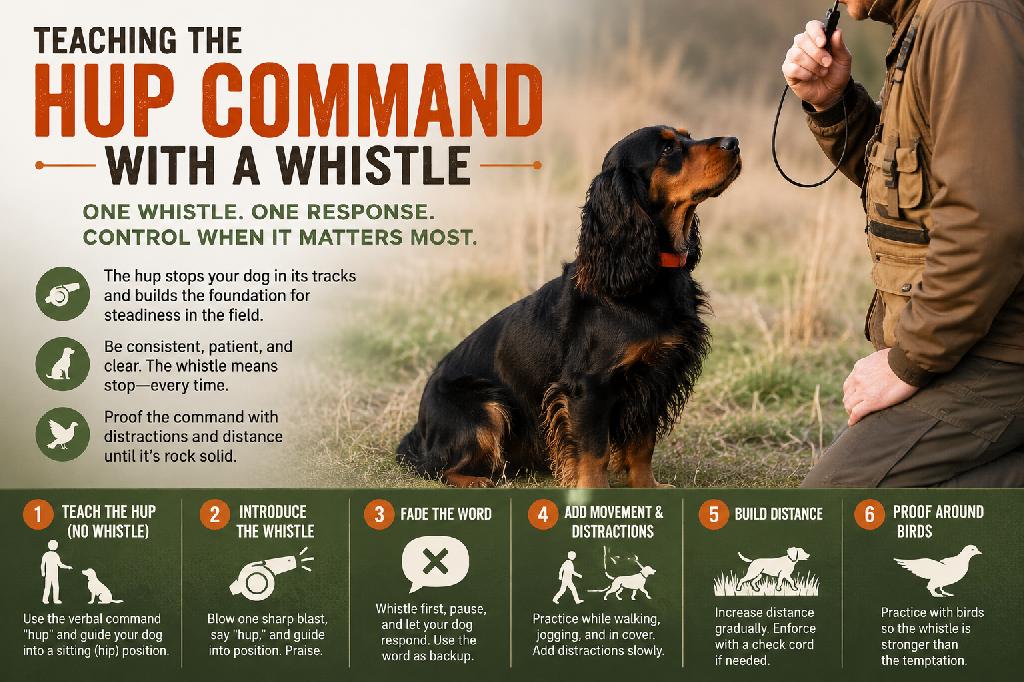
Teaching the Hup Command with a Whistle
If there is one command that separates a pleasant hunting cocker from a chaotic one, it is the hup.

Field Cocker Madness
The brace of pointers was stunning, and they were locked up on the edge of one of the thickest patches of greenbriar I'd ever seen. The tangle was so dense it resembled unfurled rolls of concertina wire. A little cocker named Rip didn't care, for when he was cut loose, he snaked his way through that mess with more moves than a belly dancer. I'd I couldn't see him, but to know where he was I just needed to see which section of greenbriar was shaking. When the dog locked on his target, a covey of wild quail exploded. They believed if they held their ground they'd never have to leave. How wrong they were.