Teaching the Hup Command with a Whistle
Building Control in Your Hunting Cocker
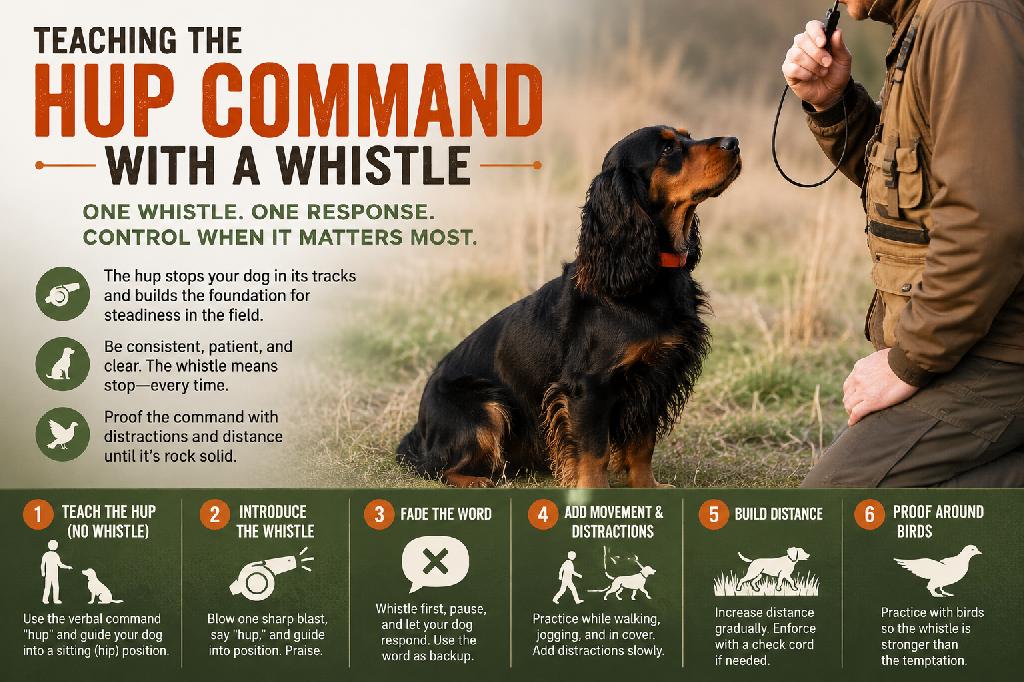
A solid hup means your dog stops immediately, plants its rear on the ground, and waits for further instruction. It is your emergency brake, your safety command, and often the foundation for everything else you'll teach in the field.
Many spaniel owners think of hup as simply another version of sit. In reality, it is much more than that. A sit in the backyard is one thing. A hup in the middle of flushing cover, with birds exploding and adrenaline flowing, is something entirely different.
The goal is simple. When your dog hears a single whistle blast, it should stop whatever it is doing and hup without hesitation.
Getting there takes a little patience.
Start Without the Whistle
Before introducing a whistle, your cocker needs to understand the physical act of hipping on command.
Begin in a quiet area with few distractions.
Stand in front of your dog and give your verbal command.
"Hup."
At the same time, gently guide the dog into position if necessary. Some trainers use a lead and upward pressure under the chin while encouraging the rear to lower. Others simply lure the dog into position with a treat.
The method matters less than consistency.
The dog should hear the word "hup" every time its rear touches the ground.
Keep sessions short. Five minutes is often enough.
Young cockers learn best when lessons feel like a game rather than a drill.
Introduce the Whistle
Once the dog reliably responds to the verbal command, add the whistle.
For spaniels, a single sharp blast is the traditional stop whistle.
The sequence looks like this:
* Blow one whistle blast.
* Immediately say "hup."
* Guide the dog into position if needed.
* Praise calmly.
Repeat this process over and over.
The whistle is not replacing the verbal command yet. It is simply becoming associated with it.
Think of the whistle as learning a new language. The dog already knows what "hup" means. Now you're teaching that a whistle blast means exactly the same thing.
After enough repetitions, you'll notice something interesting.
The dog will begin hipping before you even say the word.
That is when you know the association is forming.
Fade the Verbal Command
As your dog starts anticipating the hup after the whistle, begin reducing your verbal cue.
Blow the whistle.
Pause.
Give the dog a chance to respond.
If it hups, praise immediately.
If it hesitates, calmly follow with the verbal command.
Over time, the whistle becomes the primary cue and the verbal command becomes backup.
This transition should never feel rushed.
Every successful repetition builds confidence.
Every rushed repetition creates confusion.
Add Movement
Many dogs look perfect while standing still.
The real test comes when their feet are moving.
Start walking your dog on lead.
Give a whistle blast.
Stop your own movement.
Encourage the dog to hup.
Once that becomes reliable, increase speed.
Walk faster.
Then jog.
Then work the dog in light cover.
Each new environment introduces new distractions and new challenges.
Do not be surprised if your dog seems to forget everything it learned the moment birds, scent, or excitement enter the picture.
That is normal.
Training isn't complete until the dog can perform under distraction.
Use Check Cords to Your Advantage
A check cord is one of the most valuable training tools you'll ever own.
As your cocker begins working farther away, attach a long check cord and let the dog quarter naturally.
When you blow the whistle, enforce the stop if necessary using the cord.
The correction should be firm but fair.
The goal is not punishment.
The goal is clarity.
The dog must learn that the whistle is not a suggestion.
It is a command.
Build Distance Slowly
Many handlers make the mistake of expecting a dog to stop at fifty yards when it struggles at ten.
Distance should be added gradually.
First five yards.
Then ten.
Then fifteen.
Then twenty.
Every successful stop becomes a stepping stone toward greater range.
A hunting cocker does not need to work hundreds of yards away, but it should stop instantly wherever it happens to be.
Practice Around Birds
Eventually, the whistle must work when it matters most.
That means birds.
Start with controlled setups whenever possible.
Allow the dog to become interested.
Then give the whistle.
At first, you may need significant reinforcement.
That is expected.
Birds are powerful motivators.
The dog is not being stubborn. It is simply excited.
Stay patient and consistent.
Over time, the whistle becomes stronger than the temptation.
That is when true steadiness begins to develop.
Common Mistakes
One of the biggest mistakes handlers make is repeating the whistle.
A single whistle blast should mean hup.
Not two.
Not three.
Not six.
If you repeatedly blow the whistle, the dog learns that the first whistle can be ignored.
Another mistake is calling the dog after every hup.
Sometimes the dog should simply sit and wait.
Otherwise, the dog starts anticipating the recall instead of focusing on the stop itself.
Finally, avoid using the whistle when you cannot enforce it.
Every ignored whistle weakens the command.
Set your dog up for success.
The Finished Product
There is something satisfying about watching a well-trained hunting cocker working cover.
The dog is moving with enthusiasm, tail whipping back and forth, hunting hard.
Then a whistle cuts through the air.
Instantly the dog hups.
No confusion.
No argument.
No delay.
Just control.
That kind of response doesn't happen overnight.
It comes from hundreds of small repetitions, patient training sessions, and consistent expectations.
The effort is worth it.
Because when the birds flush, guns come up, and excitement fills the air, a reliable hup command is one of the most valuable tools your hunting cocker will ever possess.
Related Aritlces
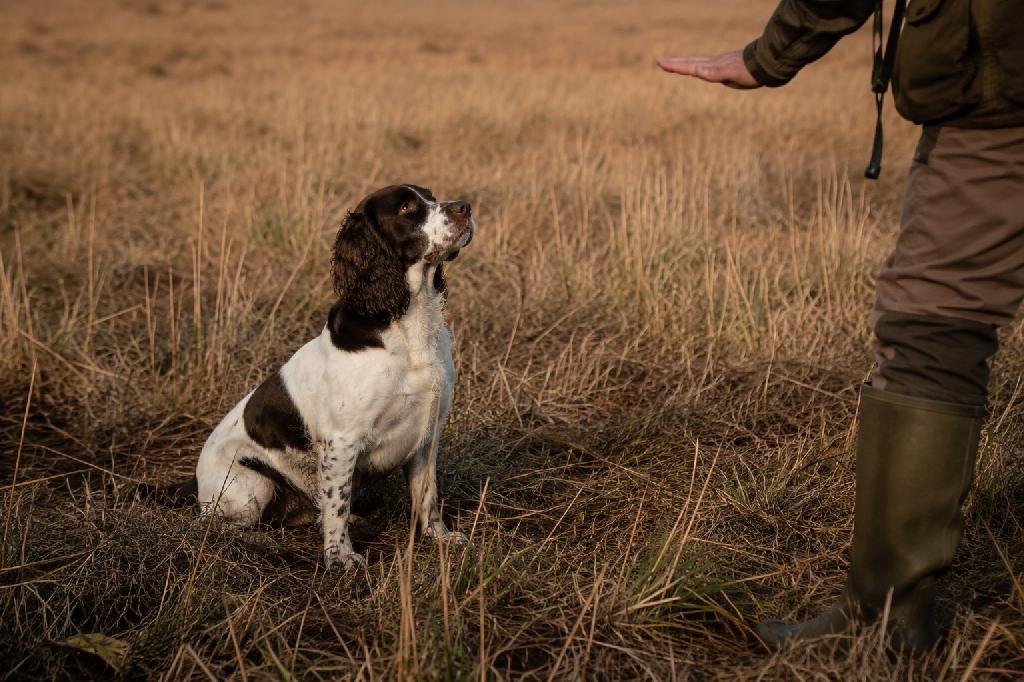
Hup or Sit?
If you've spent any time around working English Cockers, you've probably heard handlers use the word "hup" almost as often as they use a whistle.

Field Cocker Madness
The brace of pointers was stunning, and they were locked up on the edge of one of the thickest patches of greenbriar I'd ever seen. The tangle was so dense it resembled unfurled rolls of concertina wire. A little cocker named Rip didn't care, for when he was cut loose, he snaked his way through that mess with more moves than a belly dancer. I'd I couldn't see him, but to know where he was I just needed to see which section of greenbriar was shaking. When the dog locked on his target, a covey of wild quail exploded. They believed if they held their ground they'd never have to leave. How wrong they were.