Skin Laceration Repair in the Field by Shawn Wayment DVM
Upon closer inspection of the laceration, you notice it's a superficial slash in the skin and not into the deeper muscle layers. Superficial lacerations of the skin can be stapled with a little bit of veterinary knowhow and the proper supplies. Deeper lacerations into the muscle must be closed in several layers with sutures and attempts to staple will lead to a seroma (fluid trapped beneath the skin from blood and inflammation) forming and ultimately a wound that will not properly heal. A word of caution, always assess the situation of your hunting partner and use your better judgment while you're in the field. Don't let a little veterinary knowhow lead to something disastrous for your bird dog.
The following below are the steps to properly staple a skin laceration in the field. It's a very good idea to establish your bird dog(s) with a local veterinarian that truly understands hunting dogs and their perils. Furthermore, I would recommend attending a seminar or first aid course to get better educated in field emergencies and learn how to suture a wound.
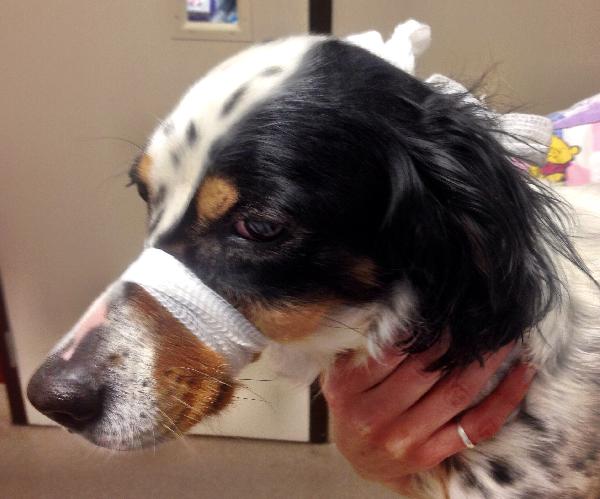
(1) Calm your bird dog and apply a gauze muzzle. Muzzles protect you from getting injured and can help calm an excited dog.
(2) Clip the hair around the edges of the wound. Clippers (battery operated work great) or scissors can be used. Reassess the laceration and make sure it is only through the skin and not into the deeper muscular layers.
(3) Flush or irrigate the wound repeatedly with diluted betadine solution (mix tap water and betadine solution to the consistency or color of weak iced tea) from a 12 cc or 20 cc syringe. The pressure from the syringed betadine/H2O solution will aid in dirt and bacterial removal.
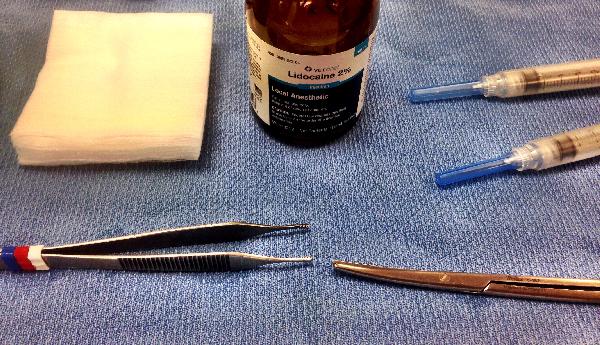
(4) 2% Lidocaine or 0.25 to 0.5% Marcaine (local anesthetic) can be used to irrigate the wound to topically anesthetize the tissue and can be injected around the laceration margins. This is where a field first aid course and a bird dog vet will come in handy. Wait 5 to 10 minutes before you proceed from here.
(5) Trim any necrotic or dead looking skin along the edges of the laceration with scissors. This will make the margins fresh and also the wound will bleed again. Bleeding brings good factors that will aid in killing bacteria and help in healing.
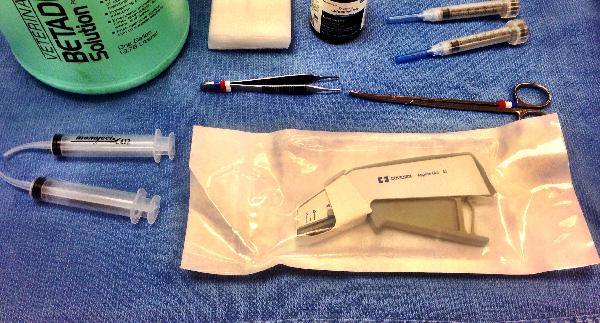
(6) Appose the edges of the laceration with the staple gun. Staples should be placed about 3 to 4 mm apart from each other. It doesn't matter with end you start at.
(7) Place Neosporin or Silvadene cream over the staples. Wrap the area (not too tight) if they can lick or traumatize the staples.
(8) Staples typically need to be removed in 14 days. Watch for swelling, redness, heat or pain associated with the area. If any of these are noted, seek veterinary attention. I typically place my patients on an antibiotic like Simplicef or Cephalexin for 7 days.
About the Author : Shawn Wayment, DVM
Visit authors website | View more articlesShawn knew at the early age of seven that he was afflicted with an obsession for bird dogs and horses; he knew then, that he wanted to become a veterinarian. After bouncing on his head one too many times as a parachuting medic with the 82nd Airborne Division, he decided to go to veterinary school. He realized his dream in 1997 by graduating from Washington State University and went into mixed animal practice. Currently Shawn has a companion animal practice in Castle Rock, Colorado. His special interest is in the veterinary care of sporting dogs and, specifically, in canine anatomy/physiology, reproduction and dentistry. In the fall, around the edges of his practice, he can be found roaming the uplands of North America chasing his cover-dog English setters. Shawn has a passion for chasing scaled quail on the shortgrass prairie with classic American doubles and pointing dogs.
Related Aritlces

Whatever you do, dont panic if you accidentally shoot the dog
My liver and white pointer Gep stood staunchly on point on a covey of scaled quail on the Colorado prairie. I hadn't seen my 6 month old coverdog-setter Gretchen for almost an hour since I turned her loose on the shortgrass prairie. My last check on the GPS showed her 700-plus yards out to the west. As I approached Gep, a large covey of scalies erupted in a whirr from the cholla as I raised my Parker GH 16 bore to pick an escaping bird. The first bird folded and I swung to pick another bird out of the covey. I pulled the back trigger just as I detected motion from the corner of my right eye...Gretchen appeared out of nowhere and it was too late. I had already fired the second barrel on a late riser just as she arrived on the scene. I was pretty sure she got peppered by the tail end of my pattern.
The Great Debate: Pointing or Flushing Dogs for Quail
My wife said I winced when we pulled up to the only game in town. It was an old motel of a vintage that reminded me of the Golden Era of travel by car. Over the years families probably over-nighted here while on their way to any one of a number of the nearby wild quail Valhallas. No visible capital improvements had been done for a long time, at least I couldn't see any renovation. The 30-some-odd rooms looked sad while the adjoining restaurant and tavern was booming.
Once Bitten...
Re-transmitted/published with permission of Covey Rise magazine. Copyright 2008. This article appeared in Covey Rise Magazine in summer of 2007.