Hi-Tech Climax
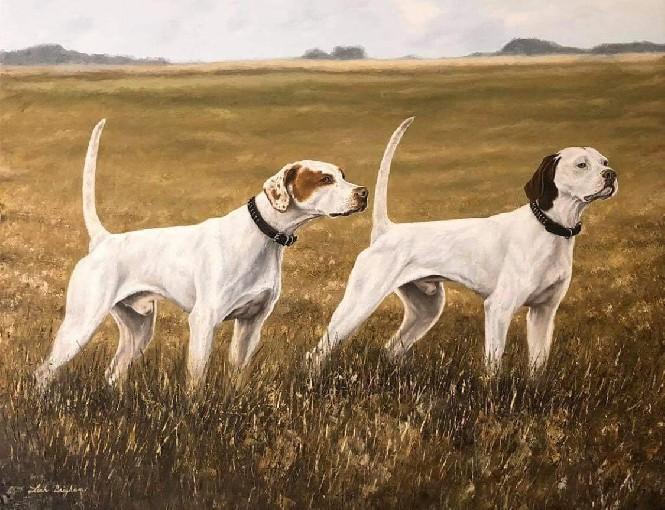
Gen-X's owner was Edward Kite, owner of the largest auto-dealer group in North Florida; Millennial's owner was Fred Reed, owner of the largest auto-dealer group in South Georgia. They had fought one another across the east-west state line for auto sales for two decades, each sponsoring continuous T-V ads in which they starred personally, first in double-knit blazers, bell-bottomed slacks and cowboy boots, later in fine wool blue blazers, gray wool slacks and Gucci loafers, to assure prospective customers of the best trade-ins, new car prices, used car prices, service prices.
This season their dogs were neck-and-neck for most Purina Points when time came for the drawing of the Masters Open Quail Championship, the major circuit's last hoorah. They drew the last brace, whether by chance or design unknown to all but the drawers.
News of the drawing lit up Facebook, Twitter, Tik-Tok and Instagram. They would come to the line on Blue Springs and finish on Nonami. The storied plantations were as usual well populated with wild quail and groomed to perfection. Grain had been generously scattered on the courses shortly before the start of the trial.
Three hundred riders were mounted in the gallery for the breakaway. Among the riders were some of the nation's most lovely female equestrians and hard-bitten male field-trialers, all astride smooth and handsome and well groomed steeds.
"Gentlemen, let 'em go," said the senior judge, and the voices of Mike and Ike rang out across the fields of green wheat and brown fallow and through the surrounding groves of live oaks and long leaf pines. The temperature was 55 F and the sky slightly overcast with a soft breeze from the south. Each dog was glimpsed on a forward right edge, then disappeared.
Each handler rode the course confidently, matching the pace set by the judges. Their scouts drifted into the piney woods on the right side of the course and disappeared. The minutes ticked off the many stop watches that had been started at the breakaway.
Soon a duel of alternating finds was underway, each signaled by the call of "point" by a scout. Each time, the pointed dog was found at a KCL off the course being run but at a place where a forward cast might logically take the pointed dog.
The two judges, themselves top amateur handlers, had met for supper and talked the night before. They had been passed certain intelligence about what might happen in the brace, and it was happening . They called in two marshals, each an employee of Blue Springs or Nonami who knew the courses like the backs of their hands, and gave them orders, plus instructions to keep the orders a secret.
Shortly the marshals returned, and the judges rode with them off the course, as if each judge needed to relieve himself. Once out of sight of the gallery, each marshal handed a judge a cell phone which the judge deactivated and placed in a saddle bag.
The dogs down finished their hours but were unseen by the judges their last twenty five minutes and were ruled out of judgment. They finished the season second and third in Purina Points.
Following the announcement of winners and taking of winners' photos the judges unobtrusively returned the cell phones to the scouts, but only after the individual who had tipped them removed an App from each phone. He was a whiz with technology, seventeen years old, and an avid amateur trialer. What the App did he did not tell the judges, but thy had figured out on their own that the phones were leading the scouts to Gen-X and Millennial on their finds.

About the Author : Tom Word
Visit authors website | View more articlesTom Word is a lawyer who represents individuals about managing their assets and for amusement writes fiction and non-fiction about bird dogs and humans obsessed with them.

About the Artist : Leah Brigham
Visit artist websiteAfter graduating from Millersville University of Pennsylvania with a Bachelors of Science in Art Education, Leah began teaching Art to inner city Middle School students in Houston and later Dallas, TX. Leah has shared with her students her passion for art and nature. This passion has sustained her and continued throughout her life in the form of painting and drawing.
Leah was introduced to American Field Horseback Field Trails and has been able to experience the excitement of seeing her own dog, competing for the National Championship at Ames Plantation in Grand Junction, TN ...standing on point, head and tail held high. This has inspired her to create works of art depicting dogs and the wildlife associated with the sport and hunting.
Related Aritlces

A Lost Dog
It was July 15, 2003 and Billy Culp was fixin’ to turn loose for a workout his first green derby of the season. He was training this year on a new place just east of Lignite and south of Route 5. There were twenty pointing dog trainers working within a forty-mile radius of Billy , two hundred or more in the state, some serious pros, some serious amateurs, some just guys with a dog or two and a pickup truck.

Field Cocker Madness
The brace of pointers was stunning, and they were locked up on the edge of one of the thickest patches of greenbriar I'd ever seen. The tangle was so dense it resembled unfurled rolls of concertina wire. A little cocker named Rip didn't care, for when he was cut loose, he snaked his way through that mess with more moves than a belly dancer. I'd I couldn't see him, but to know where he was I just needed to see which section of greenbriar was shaking. When the dog locked on his target, a covey of wild quail exploded. They believed if they held their ground they'd never have to leave. How wrong they were.
And the Birds Whistled Bob-white
Quail hunting in the South has always been as common as sunburn. Due to the fertile soil, flat and rolling coastal plains that are cut by long rivers and dotted with lakes and ponds, made for a perfect farming. Mild winters with hot, humid summers meant crops grew for longer times of the year than just about any other part of the country. Cotton, rice, peanuts, tobacco, peaches, sugar cane, watermelons, and indigo, the blue dye that comes from the plant, were staples. It didn't matter if the farming occurred on plantations several thousand acres big or on 50-acre tenant farms, one thing was for sure. Quail were abundant.