How Nutrition Supports Trainability in Your Sporting Breed Puppy
Understanding Puppy Brain Development
Eukanuba’s Scientific Services Nutritionist Russ Kelley has spent much of his career evaluating puppy development. According to Kelley, “A puppy’s brain and nervous system experience rapid growth during the formative 2 to 8 month period. In terms of mass, the brain is almost fully developed by the time a puppy is 16 weeks old. (1,2) Neurons, the cells that make up the central nervous system, are its basic functional units. Information is transmitted by neurons, which are made up of three basic parts: cell bodies, axons, and dendrites. Since the nervous system develops rapidly, nutritional support during this developmental period is critical.“

How Nutrition Can Impact Learning
Kelley has researched the impact of nutrition on learning, with a particular focus on dietary DHA in dogs and puppies. DHA, commonly sourced from fish and algae oils, is a long-chain, polyunsaturated omega-3 fatty acid that is preferentially incorporated into the membranes of neurological tissues. “The nutritional status of both the dam and the puppy can impact the growth, health, and functionality of the puppy’s central nervous system,” Kelley says. “Diets for both life stages should include DHA, as such enrichment can support brain development. DHA also has other beneficial impacts, including supporting healthy heart function and normal visual development.
[%BANNER-EUK650%]
“DHA in puppy food helps promote neurocognitive development,” says Kelley. “That’s the ability to process information and learn. DHA is initially provided via the dam during gestation and lactation. Therefore, her DHA status is very important. In fact, if she does not receive adequate levels of DHA in her diet, her DHA status will continually decline throughout the reproductive cycle. However, it is not enough just to properly feed the dam—it is also critical that we ensure puppies continue to receive optimal levels of DHA from their diet throughout the growth period.”

Multiple studies (3,4) have been conducted on the effects of DHA on puppies’ cognition. “One of the studies that involved providing fortified levels of DHA to both the dam and her puppies utilized 28 beagle litters produced from dams fed a diet that contained a low, medium, or high level of DHA,” says Kelley. “Sixty puppies (20 per diet, with a minimum of two and a maximum of three puppies per litter) were randomly selected for cognitive testing using a T-maze at between 9 and 15 weeks of age. All test puppies were weaned and maintained on their maternal assigned diet throughout testing. A total of 58 puppies (20 low-DHA, 19 medium-DHA, and 19 high-DHA) completed the test, with the high-DHA puppies significantly outperforming the low-DHA puppies.
“Another study (5) utilized 24 puppies produced from non-fortified litters that were randomly assigned to a low- or high-DHA diet post weaning. All puppies were maintained on their assigned diets from 6 to 25 weeks of age, with cognitive testing conducted from 15 to 25 weeks of age using a radial arm maze. Testing involved four graduate-based phases with advancing complexity to assess spatial memory. Puppies fed the high-DHA diets demonstrated significant improvement in long-term memory challenges, and multiple error challenges, compared to the low-DHA puppies.”

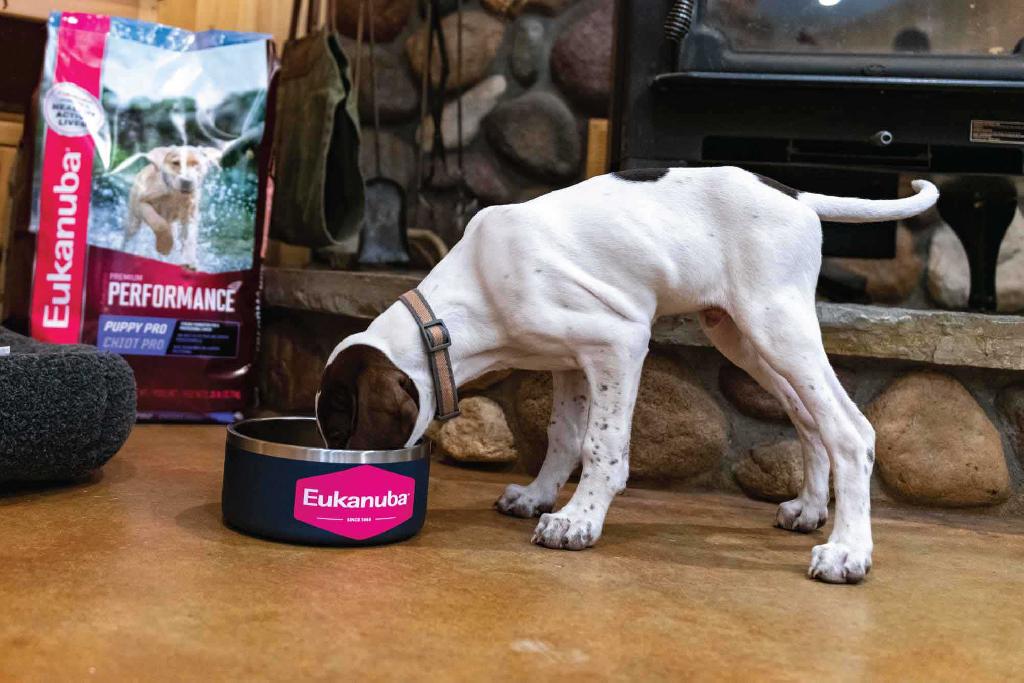
Help provide your sporting breed puppy with a training edge by feeding a DHA-enriched puppy food such as Eukanuba’s Premium Performance Puppy Pro. In addition to supporting healthy brain function, you will also be providing him with a scientifically formulated, nutrient-enriched puppy food designed specifically for the increased needs of active puppies.
1 Fox, M.W. (1971). Integrative Development of Brain and Behaviour in the Dog. Chicago and London: The University of Chicago Press.
2 Gross, B., Garcia-Tapia, D., et al. (2010). “Normal canine brain maturation at magnetic resonance imaging.” Vet Radiol Ultrasound 51(4), Jul-Aug; 361–373. doi: 10.1111/j.1740-8261.2010.01681.x
3 Kelley, R. (2008). “Linking puppy trainability and nutrient status.” Proceedings N Am Vet Conf 2008, 1575–1576.
4 Kelley, R.L., Lepine, A.J., Burr, J.R., et al. (2004). “Effects of dietary fish oil on puppy trainability.” Proceedings 6th Int Soc Study Fatty Acids Lipids Congress, 51.
5 Kelley, R. (2022). “DHA in Puppies.” Vet Focus Issue 32.1 digital version (https://vetfocus.royalcanin.com).
[%BANNER-EUK728%]
Related Aritlces

When and How to Socialize a Sporting Breed Puppy
Socializing puppies when they’re young is key to building strong and confident adult sporting dogs. Puppies need to learn about everything, which includes the environments in which they’ll live and work, people, other dogs and animals, and routine care. Read on for some tips on when and how to start socializing your sporting breed puppy.

Nutrition’s Role in Supporting Your Sporting Breed Puppy’s Immune System
A sporting breed puppy’s exposure to the natural world can occur early in life, and frequently. Introduction to the woods and waters in which they will eventually work is important for future training. However, these environments often contain pathogens that can challenge a young puppy’s immune system. Selecting a nutrient-dense diet with prebiotics and a fortified antioxidant complex can help support a puppy’s developing immune system and natural defenses. A strong and functional immune system helps a puppy’s body identify and address potential pathogens, including bacteria, viruses, and parasites.

The Importance of Mental Stimulation for Sporting Breed Puppies
Training your puppy starts the moment he comes home, and it begins with mental stimulation. Keeping him on task from the beginning will build a better adult sporting dog—but how do you do it? Read on for advice on how to hold a puppy’s attention.