The Joy of Cover Dogs - By Tom Keer

As animals were added to the family farm, the rocks were stacked to create natural fences, ideal for herds of sheep and goats. These were called tossed walls, and they originally were single rows. When horses and cattle arrived on the scene a second row was added for increased strength, durability and height. The pinnacle of stone barriers are known as laid walls. These geometrically-arranged stones were fit together as if they were a piece of art like a mosaic. Laid walls took time to build, and they revealed a landowner's wealth which usually was significant.
No matter what kind of walls I find during bird season I listen to them speak. They tell me about the hardworking farmer and his family who struggled until one day they gave up. Maybe they took a job in a city or maybe they pursued opportunities out West. Known not to them, their abandonment had a happy ending. A rebirth came from their relocation, and it was a regeneration of young forests growing in the clearings they left behind. Grouse and woodcock, descendants of the original Pilgrim-era stock followed, and pursing them are we bird hunters. To this day whenever I see any variety of stone walls I park my rig in an inconspicuous area and put down a dog for a run.

For this type of terrain, a cover dog works best. Breed isn't as important, but ability sure is. By breed standards, cover dogs are slightly smaller so they can athletically navigate through the tangled mess of alder and aspen runs and twisted briars and vines. Setters, pointers, Brittany's and shorthairs with genetics that contain knowledge of how to carve up the jungle is a plus. A head packed with bird smarts and a nose to differentiate foot from body scent is critical. A cracking tail that indicates their joy in accepting such a difficult challenge is a matter of personal preference. In fact, these days you may see more Griffs and Drahthaars than pointers and setters.
These cover dog specialists work at a pace that allows for hunters snaking their way through a young alder or aspen run to keep up. Good dogs have the wheels to move out in front, to cast from side to side, and to check in with handlers before advancing onward. That cover dogs run inside of bell range doesn't make 'em bootlickers. On a windy day, bell range in the grouse woods might be inside of 100 yards while on a calm day it may be close to a football field and a half. If you don't like a bigger running dog with a CH or RUCH prefix in its name then find one that casts closer to your liking. But a good cover dog will scour the countryside in search of birds, even if it's inside of 50 yards.
Bird finders of the highest order differentiate between grouse and woodcock that inhabit alder, poplar, and aspen runs, stands of spruce or fir trees, and the smorgasbord of soft and hard mast and leafy greens. They know to check under a pine bough on a wet day as much as they head to the alder hells when it's bone dry. After a killing frost they'll look for grouse feeding among fallen apples trees and drooping highbush cranberry branches, and if nobody is home, they'll look for birds feasting either on ferns or grazing in witch hazel and wintergreen. Dogs capable of such performances are athletic indeed, and they twist and turn like an Olympic platform diver. To keep up, hunters should be conditioned. For those of us who have neglected summer two-a-days, well, we can always visit a chiropractor.
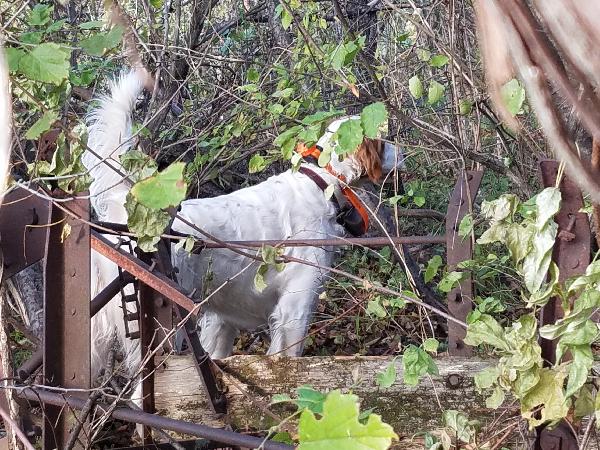
Cover dog aficionados are split when it comes to a coat and coloration. Setter or Brit fans favor long hair as it keeps Hawthorne tines and bull briars at bay, while a pointer or shorthair's high-and-tight is ideal for early season heat. White dogs are easier to spot in thick foliage while dark dogs stand out when the snow falls. You can see Gordon setters in the early season jungle just as you can see a setter in the snow, so take your pick. Hunt what you like so long as they are biddable and check in from time to time.
Grouse and resident woodcock are notorious track stars, so dogs will relocate several times after an initial bird contact. Running grouse have all the stutter-steps of an All-American halfback while running timberdoodles are as graceful as a lineman doing an endzone dance. Juxtapose them with stationary flight woodcock and you'll need a dog with enough savvy to present a hunter with Check Mate.
Cover dogs are at home in cover, but they're popular in other areas, too. Shawn Wayment, the Birddog Doc, favors cover dogs for his favorite Western birds in Colorado, Idaho, New Mexico and Arizona. Pro trainer Tracy Lieske likes 'em for foot-hunting Tennessee bobs. Irregardless if a tail flies high or a docked-tail raises, the enjoyment of watching these dogs work in terrain that seems impenetrable is inspirational. Cover dogs have stories to tell. Just like an ancient New England stone wall itself.

About the Author : Tom Keer
Visit authors website | View more articlesTom Keer owns The Keer Group, an outdoor marketing company which works perfectly with his freelance writing career. He casts his four English setters in Northeast upland coverts and Southern quail fields with fortunate regularity. Hes been lucky to be surrounded by people and dogs that are much smarter than him. Visit him at www.thekeergroup.com or at www.tomkeer.com
Related Aritlces
Whatever you do, dont shoot the dog - By Tom Keer
I've never seen a bird dog get shot, but I hear of at least one instance per year. When the stories roll in I get sick to my stomach. They unfold in pretty much the same way. A group of folks review the pre-hunt safety talk. All have heard it before, all are in agreement. The dogs are cut loose, the hunt is underway, and spirits are high. Jokes fly around, conversation is light, and everyone agrees they are more happy in the field than at work.
The Great Debate: Pointing or Flushing Dogs for Quail
My wife said I winced when we pulled up to the only game in town. It was an old motel of a vintage that reminded me of the Golden Era of travel by car. Over the years families probably over-nighted here while on their way to any one of a number of the nearby wild quail Valhallas. No visible capital improvements had been done for a long time, at least I couldn't see any renovation. The 30-some-odd rooms looked sad while the adjoining restaurant and tavern was booming.
SportDOG: Gear the way youd design it
My dentist, Doc Biehn, was a waterfowler and I always got to check it out when I got my teeth cleaned as a kid. I remember one visit when he handed me a new, Marlin Super Goose he extracted from his closet. I'd never seen anything like the 10 gauge, bolt action shotgun that took a 3.5 inch shell and came with a two-shell clip and full-choked 34-inch barrel. That beast weighed a whopping 10.5 pounds, making it a virtual shoulder-cannon for waterfowlers. I could barely lift the heavy artillery let alone work the bolt without significant muzzle rock. My amazement turned to confusion, and in the end I couldn't see how that firearm would replace my side-by-side or pump in the blind. The Super Goose must have been designed by someone who didn't hunt geese.